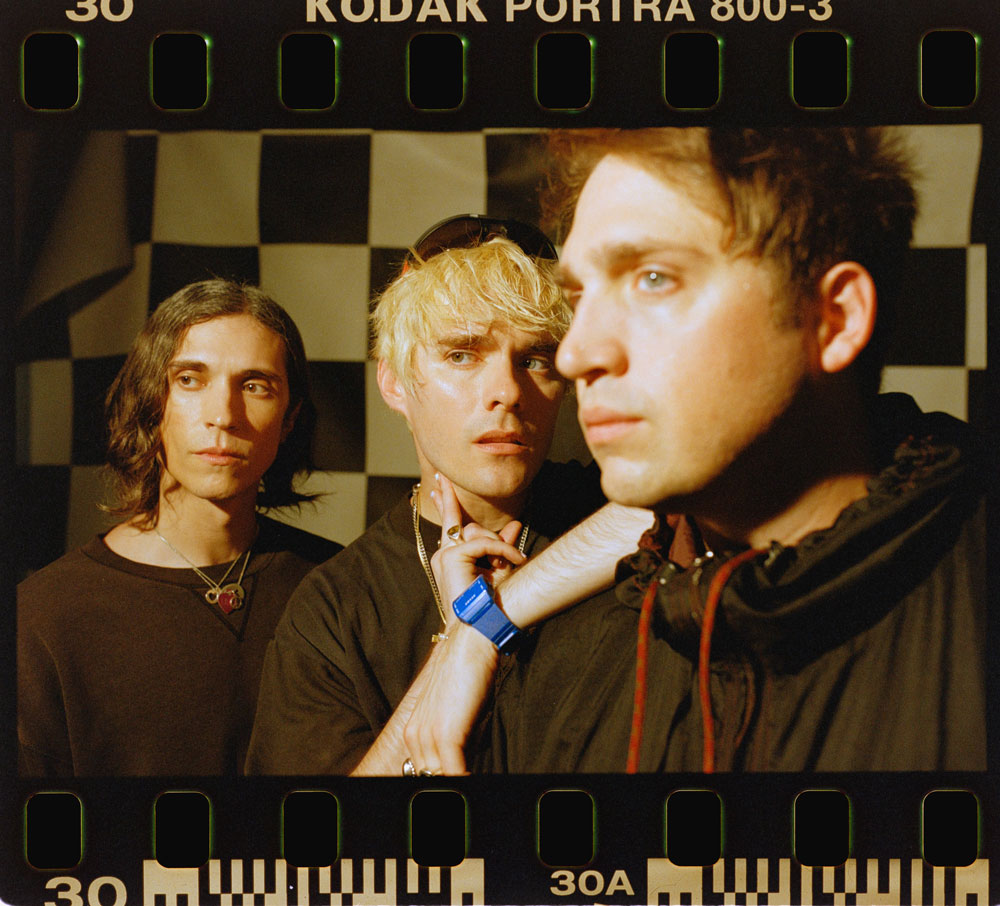
Waterparks writes anthems that define artistic eras. Each arrives emotionally precise, sonically distinct, and color-coded before yielding to the next. Over the past decade, that approach has turned the trio of Awsten Knight, Geoff Wigington, and Otto Wood into one of modern rock’s most vibrant, shapeshifting success stories: 1 billion catalog streams, a No. 1 Alternative Album in the U.S., Top 10 albums on both sides of the Atlantic, constant social media chatter, and alt-magazine covers.
But numbers were never the point. Waterparks measure success in less tangible ways. It’s in the connection between artist and audience, whether headlining theatres or festivals or supporting My Chemical Romance on a sold-out arena run. And it’s in the ambition of the art itself. Does what they’re making matter? Is this art, this music, consistently exciting, challenging, and overwhelmingly alive?
Their commitment to evolution places Waterparks in lineage rather than category. Like the longest‑lasting acts to emerge from the alternative ecosystem (bands whose careers are best understood as sequences of reinvention rather than linear progress), they are deeply rooted in the culture that raised them while adamantly coloring beyond its established boundaries. Their music absorbs scale, theatricality, intimacy, chaos, and clarity without hierarchy. Eclecticism is a way of life.
Waterparks is a living document of who the band was at the exact moment each song surfaced. Knight’s world-building draws lines between beginnings and endings with near‑architectural precision. Each era is defined by sound and image, sometimes right down to the vibrant hue of his hair. JINX, the sixth full-length chapter in their constantly evolving musical story, is an unparalleled achievement.
The band looks forward, not backward, every step a testament to life and forward motion. That forward tilt has become the band’s defining trait, even as their fanbase grows large enough to romanticize the past. Their biggest streaming hits thus far, “I Miss Having Sex But At Least I Don’t Wanna Die Anymore” (2019) and “Stupid for You” (2016), are a stark contrast in sonic texture and emotional dynamics. Waterparks take creative risks without sacrificing gigantic melodic hooks. Like the most transcendent lifers, from Queen to Madonna to Fall Out Boy, Waterparks thrive by evolving faster than expectations can catch them, with career-spanning setlists that balance eras cohesively.
Ask Awsten Knight why the moment necessitated a new artist bio, and he doesn’t talk about legacy. He talks about velocity. “That’s where I like to live,” he says. “I like to put Waterparks in the future.”
That philosophy guided the creation of JINX, the band’s sixth full‑length album, and the most deliberately constructed chapter of their career. Rather than continuing an expected trajectory, Waterparks chose disruption: leaving behind familiar creative routines, restructuring their working relationships, and changing the physical environment in which the album took shape. JINX exists in the wake of a decision to walk away from a nearly completed version of their sixth album and rebuild from scratch. “I operate on instinct,” Knight says. “If something doesn’t feel right, I’ll abandon it.”
Zakk Cervini (5 Seconds of Summer, Bring Me The Horizon) produced FANDOM(2019), co-produced Greatest Hits (2021) and INTELLECTUAL PROPERTY (2023), and returned to work on JINX.
They also struck up a creative partnership with Nick Zinnanti, leaving the familiar comforts of Los Angeles for the producer/songwriter’s Long Island studio, which felt less like a workplace than a surreal installation, filled with themed rooms, odd artifacts, and visual noise.
But that immersion (and constant back-and-forth travel) proved catalytic rather than distracting. Knight describes the process as one of testing rather than accumulating; interrogating songs until they revealed whether they could exist outside their moment of creation, like his own favourites.
“When I was really young, I could hear a song and just know if it was special,” he says. “It has to be timeless, or I don’t want it.”
“TELL ME WHY” begins the album with cinematic flair without sacrificing emotional intimacy. A story of death, purgatory, confrontation, and return, anchored by the chorus: “If the only point of life is not to die, can you tell me why?” Casting the roles of God, the Devil, et al. for the song combined wish fulfillment and serendipity.
“It feels like a magic trick,” marvels Knight. “Grand, gothic, dramatic, industrial; a perfect mixture.”
That deliberate juxtaposition runs throughout JINX, with each song asserting its purpose rather than blending into a palette. “PROWLER” is a study in isolation and reckoning. It’s a song about feeling unmoored and learning to live within that discomfort rather than outrun it. “RED GUITAR” snaps in the opposite direction, confrontational and hyper-present, with swaggering hooks. “IF LYRICS WERE CONFIDENTIAL” weaponises humour, folding cutting internal commentary into a song that thrives on tension. “ANY MINUTE NOW” slows the frame entirely, turning vulnerability and reflection into atmosphere, with its restraint functioning as its own form of intensity. Even at its most aggressive or surreal, JINX remains tightly composed, its chaos not accidental but carefully arranged.
“This album came from so many versions of me,” Knight observes, with a knowing laugh. “There’s, like, ten versions of me on it, looking back. Like, ‘Damn, we had the whole crew here.’”
That multiplicity has always defined Waterparks. The band lives in the tension between charm and abrasion, sincerity and irreverence, building songs that can disarm as quickly as they hit.
It’s a balance that runs across all six albums thus far. Each era raises the stakes. The scope widens, the ideas sharpen, and the band keeps moving forward, faster than expectations can settle around them.
“My creative competition is me,” Knight says. “And I’m hard to beat.”