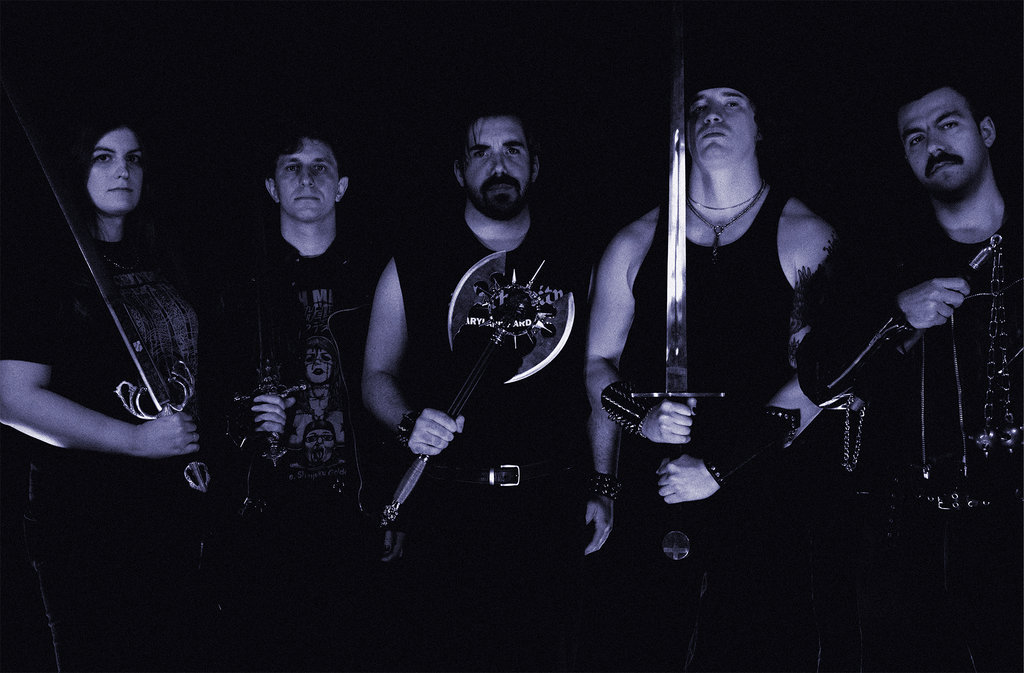
There is something wonderfully unfashionable about Ninth Realm.
While plenty of modern metal bands seem determined to make their music increasingly complicated, increasingly pristine and increasingly difficult to actually remember, this Maryland outfit has taken the opposite route. Their weapons are riffs, hooks, attitude and the sort of songwriting that makes you instinctively want to bang your head before you’ve even worked out what the hell is happening. But don’t mistake simplicity for a lack of ambition.
Ninth Realm have spent the last several years constructing their own mythology, dragging the traditions of death metal, thrash, hardcore, black metal and classic heavy metal into a fantasy world of their own making.”Damnation’s Veil”, their second full-length, is where that approach really starts to feel fully formed.
The result is a record that sounds as though Iron Age, Bolt Thrower, Mercyful Fate, Power Trip, Celtic Frost, Bathory, Dissection, Autopsy and Candlemass were locked inside the same rehearsal room, handed a map to a fantasy kingdom and told that only one of them was getting out alive. The band openly acknowledges those influences, but the important thing is that Ninth Realm don’t simply recreate them. They use them as building blocks.
And when the opening sounds of “Valigeth” begin to creep through the speakers, it becomes pretty clear that this isn’t going to be a polite journey.
It is a fucking march into battle….
Ninth Realm was formed in Maryland and the surrounding DMV area in 2019, although the story actually begins slightly earlier. Drummer Joey Burke and lead guitarist Liam McMahon started the project while studying at the University of Maryland, bonding over their shared love of heavy metal and high fantasy. They began writing and rehearsing together before producing their first demo, “Gates of Tythorin”, in 2019.
The concept was never to write some old-school metal and stick a sword on the cover. Burke had created an original fantasy world called “Tythorin”, and Ninth Realm’s music would become the soundtrack to it. The world is built around themes of vengeance, fate, grief, trauma and human resilience, giving the band’s music a narrative framework that goes beyond the usual collection of demons, death and vaguely medieval artwork.
The early recordings established the formula. Following the 2019 demo, the band released the “All Hail Treachery” EP in 2020, further developing their blend of thrash, hardcore and traditional heavy metal. In 2022, “Ondreis MMXXII” was released, a promo tape containing two tracks that would subsequently appear on their debut full-length. Then came “A Fate Unbroken”.
Released in 2022, the debut was the record that properly announced Ninth Realm to the underground. Tracks such as “Gates of Tythorin,” “Plea to the Heavens,” “Witches Choir,” and the title track “A Fate Unbroken” demonstrated a band who understood that crossover didn’t have to mean watering metal down.
Quite the opposite. They were taking the aggression of hardcore and punk and injecting it directly into traditional metal songwriting.
Reviews of the debut picked up on that quality, with comparisons ranging from Iron Age and Power Trip to Eternal Champion and High Command. It felt like an attempt to reunite heavy metal and hardcore punk with their raw old-school roots, while mixing Celtic Frost-style aggression, classic heavy-metal melody, and crossover influences.
The lineup at the time featured Joey Burke on drums, Liam McMahon on lead guitar, Charles House on rhythm guitar, Ben Hageage on vocals and Jared Henry on bass. By the time”*Damnation’s Veil” arrived, Amelia Morris had taken over bass duties, joining Burke, McMahon, House and Hageage in the current five-piece lineup.
And the change is significant. Because this isn’t simply “A Fate Unbroken Part II”.
“Valigeth” begins the album with roughly ninety seconds of ominous atmosphere. It’s a smart move.
Rather than immediately throwing the listener into the riffing, Ninth Realm creates the feeling of approaching something enormous. There is an almost cinematic quality to the introduction, like stumbling through a ruined kingdom and hearing something unpleasant moving somewhere beyond the next wall.
Then the title track arrives. “Damnation’s Veil” doesn’t so much open the gates as kick them off their hinges.
A dark, Phrygian-flavoured riff establishes the mood before the guitars begin shifting between muscular thrash and heavier death-metal weight. The song has that wonderful quality of sounding enormous without actually requiring a great deal of technical wizardry.
The riff does the work. And that is something Ninth Realm understands exceptionally well. The guitars of Charles House and Liam McMahon form the centre of the record. House’s rhythm work provides the blunt-force impact, while McMahon gets plenty of room to introduce melodic leads, harmonised lines and more traditional heavy-metal flourishes.
There is a real understanding of contrast. You get the sharpness of thrash.
Then the weight of death metal, then the swagger of hardcore.
Finally, suddenly a melody that sounds as though it has escaped from an early-’80s heavy-metal record.
It shouldn’t necessarily work. But it does.
“Cohorts of the Abyss” continues the assault, bringing a more obvious death-metal flavour into the equation.
This is where the band’s relationship with old-school extremity becomes particularly apparent. There is an Entombed-like crunch to parts of the guitar sound, while the riffing occasionally carries the grimy character associated with early death metal.
But Ninth Realm aren’t interested in becoming a straight death-metal band.
The hardcore influence remains embedded in the structure. There is always a point where the song feels designed to be played live.
That is something one of the more critical reviews of the album noted. “Last Rites” argues that much of the album’s riffing is deliberately straightforward and geared towards the live environment, criticising what it sees as a tendency towards predictable structures.
It’s a fair criticism. But it also depends entirely on what you want from heavy music.
If you’re searching for progressive songwriting full of unexpected harmonic detours, “Damnation’s Veil” probably isn’t going to change your life.
If you want riffs that make you want to throw yourself into a sweaty room with 300 other lunatics, Ninth Realm ARE considerably more convincing.
“Imbued in Hellfire” is one of the album’s immediate highlights.
There is something wonderfully old-school about the way the song is constructed. It has the sense of forward motion associated with classic thrash, but the guitar tone and vocals give it considerably more weight.
Ben Hageage deserves considerable credit here. His voice isn’t polished.
It isn’t designed to sit comfortably inside some perfectly compressed modern metal production. It has aggression. It has rasp. It sounds like somebody who actually wants to fucking hurt you.
His delivery is one of the things preventing the record from becoming merely a collection of riffs. He gives the song its personality, particularly when the music shifts between death-metal growls, harsher shouted passages and more venomous attacks.
The vocals are another area where Ninth Realm have clearly developed since their debut. There is more confidence here—more authority & a harsher bite.
Then comes “Rituals in Thar’amath”, and this is where Joey Burke decides that keeping the peace was never really an option. The drums are ferocious.
There are blast-beat passages, driving thrash rhythms, punk-inflected momentum and enormous shifts into heavier territory. What makes the track particularly effective is that Burke doesn’t make the speed feel clinical.
It sounds physical. The drumming has that slightly rough-around-the-edges quality that gives extreme metal its character. The band hasn’t attempted to sterilise every hit until it becomes a mathematical event. Instead, it sounds like a human being attacking a drum kit. That distinction matters.
The song also demonstrates how well Ninth Realm understands the value of a breakdown. There is no desperate attempt to bolt a breakdown onto the song simply because modern metal expects one.
The heavier passage arrives naturally. The whole thing slows. The bass becomes more prominent. The guitars become heavier.
And suddenly you’ve gone from running across the battlefield to standing in front of the enemy waiting for somebody to make the first move.
“Wyrd of Strideborne”: This is one of the most interesting songs on the record because it lets the band’s traditional heavy-metal side come to the fore.
The riffing becomes more melodic. There are harmonised guitar lines.
There is a more obvious sense of galloping momentum.
It is still heavy, but there is an almost triumphant quality buried inside the darkness. This is where the Mercyful Fate, Bathory and NWOBHM influences become more apparent. Ninth Realm are at their best when they allow all of their influences to collide rather than keeping them in separate boxes.
“Beyond the Void” is probably the clearest representation of what Ninth Realm has become. The central riff is massive. Not complicated. Not particularly flashy. Just MASSIVE.
The song combines groove-heavy death-thrash riffing with blackened melodic passages and a more traditional metal approach to lead guitar. McMahon’s solos provide flashes of melody without turning the track into a guitar showcase.
Everything serves the song. That is the key.
The guitars don’t exist so McMahon can demonstrate how quickly he can move his fingers. The drums don’t exist to demonstrate Burke’s blast-beat stamina.
The vocals don’t exist to overpower the music. Everything is arranged around the riff.
A title like “Vengeance Unto Rot” sounds like it was designed specifically for a record like this.
The track itself is another demonstration of the band’s ability to balance momentum and weight. Some riffs sound designed for a circle pit.
Others feel more suited to standing still with your fists clenched while the vocalist screams at you.
That crossover DNA remains fundamental to Ninth Realm. There is a punk simplicity underneath the metal sophistication.
You can hear why the band have been associated with Power Trip, Iron Age and High Command. Still, Ninth Realm also possesses enough traditional-metal sensibility to avoid sounding like a straight-up crossover revival act.
They are not simply trying to resurrect 2012. They are reaching further back.
“All Hail Treachery” is a short, furious reminder of where the band came from.
The title itself reaches back to the band’s 2020 EP, creating a subtle link between their early material and this new chapter.
At barely over two and a half minutes, it gets in, causes damage and gets out.
No fat. No unnecessary detours. Just riffs. This is probably where Ninth Realm’s songwriting philosophy is most obvious.
They understand that a song doesn’t need to be long to be memorable.
In fact, some of the band’s strongest moments come when they refuse to overstay their welcome.
Then comes “Twilight’s Blade”, and suddenly everything makes sense.
The closing track is slower, darker and more expansive, beginning with a doom-laden weight before gradually incorporating the melodic and aggressive elements that have defined the rest of the record.
There are moments here where the influence of Candlemass and traditional heavy metal is particularly noticeable, while the darker guitar work hints at black metal. The track feels like a final battle.
Not because the lyrics need to tell you that. Because the arrangement does.
The pace slows. The riffs become broader. The melodies become more pronounced.
And eventually the record feels like it is disappearing into the horizon after the fighting has stopped.
It’s a suitably cinematic ending to an album built around fantasy and conflict.
One of the most interesting aspects of Ninth Realm is the way their fantasy concept informs the music without completely dominating it.
There are plenty of metal bands who adopt fantasy imagery and end up sounding like they’re auditioning for the soundtrack to a second-rate tabletop role-playing game.
Ninth Realm avoids most of those traps. The Tythorin concept gives the songs a sense of place. But the music itself remains grounded.
There is blood under the fantasy. This isn’t orchestral power metal.
There are no choirs of angels floating above the riffs. There is dirt, sweat & hardcore aggression.
Old-school metal. That is why the concept works.
Recorded between April and July 202*, the album’s instrumental tracks were recorded with Matthew Michel at Viva Studios in Fairfax, Virginia, while Sebastian Philips recorded Hageage’s vocals at his home studio in Dundalk, Maryland.
The production walks a useful line between modern clarity and old-school aggression. The guitars are thick enough to hit hard, but detailed enough for the melodies to remain audible.
The drums retain their physicality. The bass isn’t completely buried.
And Hageage’s vocals sit where they should: directly in the listener’s face.
The result is a record that sounds modern without becoming overly polished.
That is important because “Damnation’s Veil” relies heavily on physical impact.
This is music that should sound good through a pair of headphones, certainly, but it feels designed for an amplifier. You can practically hear the rehearsal room.
You can imagine the riffs bouncing off the walls. You can imagine the crowd reaction.
In the end, there are two ways of approaching “Damnation’s Veil”.
You can analyse every riff and complain that you’ve heard something similar before. Or you can put the record out loud, stop overthinking it, and allow the Ninth Realm to do what they clearly intended… Make heavy fucking metal.
Yes, there are familiar ingredients. Yes, the death-thrash foundation isn’t exactly revolutionary. Yes, some of the structures are predictable.
But none of that changes the fact that this is a seriously enjoyable record.
The riffs are memorable. The guitars have personality. The drums hit hard.
The vocals are aggressive. The production gives everything enough room to breathe. And most importantly, Ninth Realm understand what makes a great song.
They don’t simply write riffs and hope they stick. They build tracks around them. “Damnation’s Veil” is a band actually becoming a total entity.
They have taken death metal, thrash, hardcore, black metal and traditional heavy metal and thrown them into the same cauldron without allowing any one ingredient to dominate completely. And that is harder than it sounds.
Ninth Realm doesn’t reinvent the wheel. They sharpen it.
If you like your metal with riff worship, fantasy mythology, crossover aggression, old-school death-thrash, galloping heavy-metal melodies and enough attitude to fill a small castle, Ninth Realm have built your next soundtrack.
The gates of Tythorin are open. Armies are waiting on the other side.
And judging by “Damnation’s Veil”, they aren’t coming in peace.
Review: Joseph Mitchell
Damnation’s Veil is out via Transcending Obscurity Records on 28th August 2026
Cover art by Jerry “Wyrmwalk” Hionis (Maul, Celestial Sanctuary)
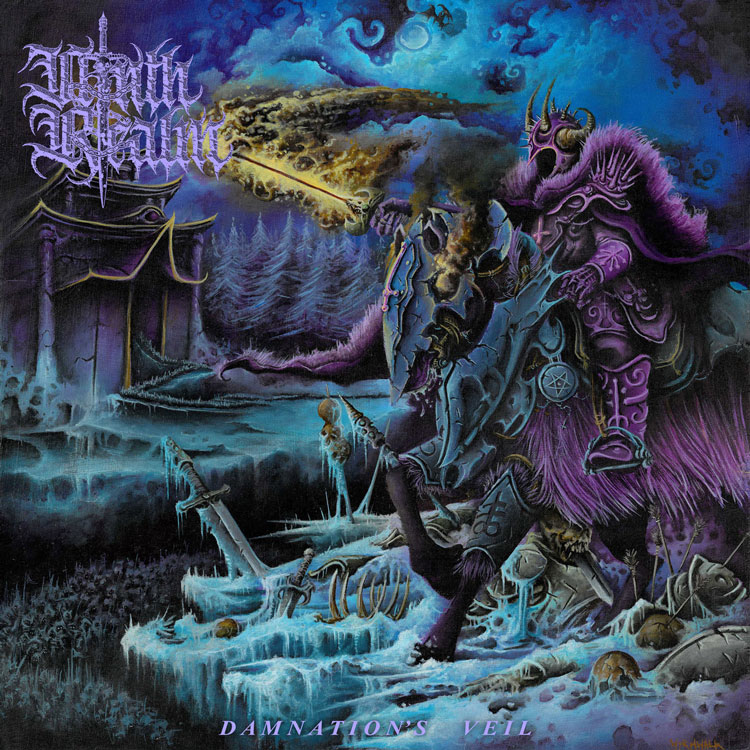
Track listing –
1. Valigeth
2. Damnation’s Veil
3. Cohorts of the Abyss
4. Imbued in Hellfire
5. Rituals in Thar’amath
6. Orphaned Throne
7. Wyrd of Strideborne
8. Beyond the Void
9. Vengeance Unto Rot
10. All Hail Treachery
11. Twilight’s Blade
Line up –
Amelia Morris – Bass
Charles House – Rhythm Guitar
Ben Hageage – Vocals
Joey Burke – Drums
Liam McMahon – Lead Guitar
Official Transcending Obscurity Site
Transcending Obscurity Facebook
Ninth Realm Instagram
Official Label YouTube Channel
Label US Store