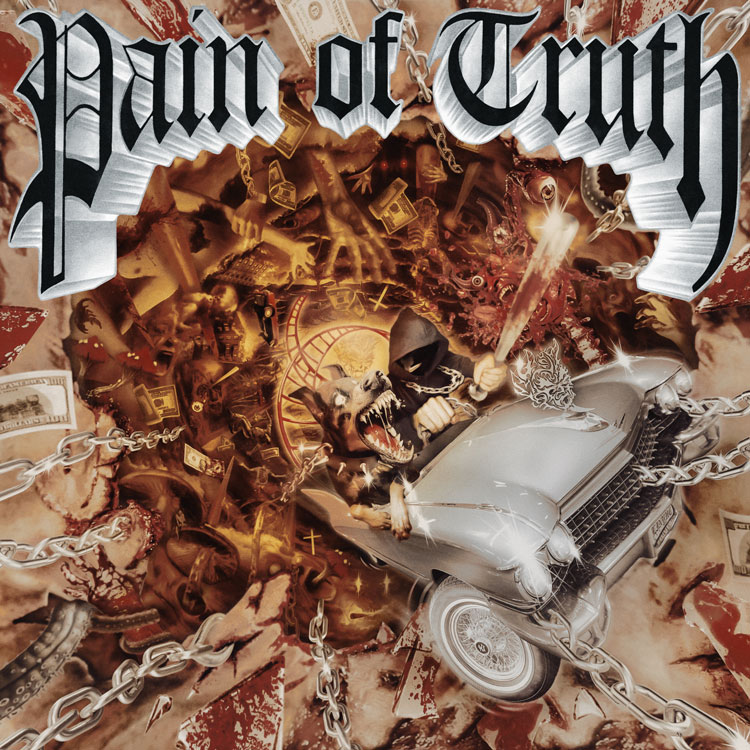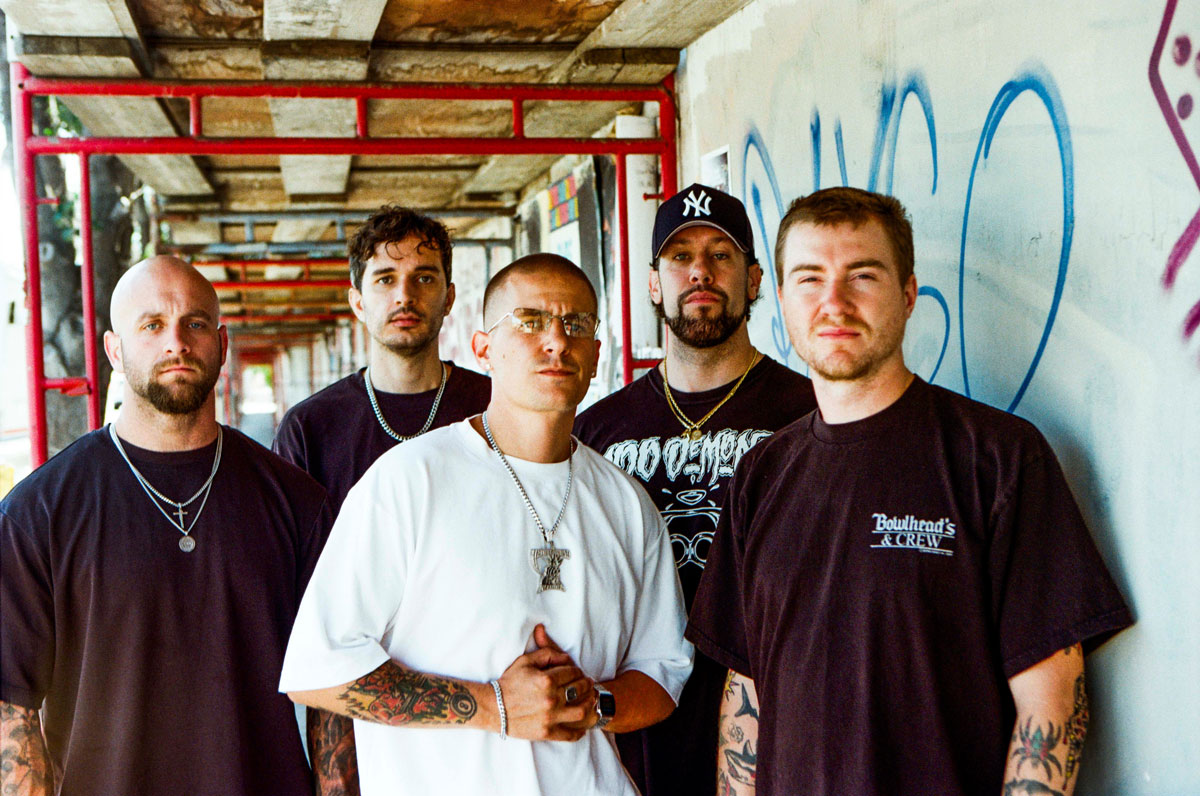
Pain of Truth has never sounded like a band interested in standing politely at the back of the room. Since emerging from Long Island in 2020, the five-piece have built their reputation around the physical side of hardcore: music designed to be shouted back, jumped to, crashed into and, eventually, carried home in bruises.
With “Pain Of Truth”, however, something has shifted.
Michael Brian Smith, Nik Hansen, Ridge Rhine, Zach Stachura and Nick Barker have taken the foundations laid down on “No Blame…Just Facts” and 2023’s “Not Through Blood” and reinforced them with concrete.
Their self-titled second full-length is heavier, sharper, and considerably more ambitious in its songwriting, while retaining the swagger, hostility, and communal spirit that made the band such an important force in contemporary hardcore.
The album arrives after years of relentless touring, including appearances alongside Terror, Madball, Knocked Loose, High Vis, Speed and Counterparts, as well as sets at Sound and Fury, Outbreak, Ieper Fest and Sick New World. That live education is all over this record.
But “Pain Of Truth” isn’t simply a studio recreation of the band’s live show. It sounds like a band deliberately expanding the boundaries of what that show can become.
Recorded, mixed and mastered by Will Putney, the production gives Pain of Truth a considerably more muscular sonic identity. Putney’s involvement is important because the album never feels scrubbed clean. The guitars have weight, the drums hit with frightening definition and Smith’s vocals sit firmly at the centre, but there remains enough abrasion around the edges to retain the feeling that this music belongs in a sweaty room rather than behind glass.
And then there are the gang vocals.
They are everywhere, transforming individual confrontation into collective resistance. That is perhaps the biggest difference between the Pain of Truth of old and the band heard here. Previous releases were packed with guest appearances from the likes of Terror, Madball, Trapped Under Ice and King Nine. This time there are no guests. This is Pain of Truth standing entirely on their own.
The result feels less like “me versus you” and more like “us versus them”.
The album kicks the door down with “Obliteration”, an immediate statement of intent. The guitars have a darker, more metallic edge than much of the band’s earlier work, while Barker’s drums provide the engine underneath it all. Smith sounds completely at home over the heavier backdrop, barking his way through the track with the kind of vocal authority that demands an audience respond.
Then come those gang vocals, turning the song from a performance into an instruction. It is easy to imagine a packed room moving as one.
“Stranded” takes that formula further. The riffing is one of the clearest examples of the band’s development, combining hardcore’s blunt-force rhythmic attack with a heavier guitar vocabulary. There is a deliberate sense of movement in the arrangement, with the rhythm section constantly pushing and pulling against the guitars.
Barker deserves particular attention here. His drumming doesn’t simply keep time; it creates the spaces where the riffs can land. The album’s heavier moments work because the drums understand when to accelerate and when to let a groove breathe.
That groove is central to “Pain Of Truth”.
The band understands that hardcore doesn’t have to move at one speed to remain violent.
“Unforgiven” is perhaps the clearest example. Released as one of the album’s previews, it carries a surprisingly positive core beneath all the aggression. Smith described the song as being written to offer a sense of hope during terrible times, focusing on turning energy and adversity into action.
That sense of resistance gives the song an extra dimension. It isn’t anger for the sake of anger. The music feels like forward momentum.
Hansen and Rhine’s guitars repeatedly switch between chunky rhythmic patterns and sharper, more electrifying passages, while Stachura’s bass keeps everything grounded. Putney’s production allows the individual instruments to remain identifiable without taking away the density that makes hardcore so effective.
Then comes “Chinatown, NY”, a track that feels particularly connected to the band’s roots.
There is something deliberately old-school about its approach, but the performance has the confidence of a band that knows exactly where it sits in the modern hardcore landscape. The gang vocals become almost architectural, building a communal wall around Smith’s voice.
The lyrics return to ideas of identity, division and refusing to accept a lifestyle that doesn’t belong to you. It is one of the album’s strongest examples of Pain of Truth using simplicity as a weapon.
“Fed By Fear” moves into darker territory. The song’s central idea is manipulation and division, with fear as the mechanism used to control people. Musically, that sense of unease is reflected in the heavier, more deliberate groove.
The guitars sound enormous here.
Rather than simply piling distortion upon distortion, the band gives the riffs space to breathe before crushing the listener again. Smith’s delivery has a particular venom, while the backing vocals turn certain lines into something that sounds less like a lyric and more like a crowd chant.
This is where the Putney production really earns its place.
There is clarity without sterility. Every hit of Barker’s kit carries weight, Stachura’s bass gives the low end genuine physical presence, and the guitars retain enough grit to prevent the record from becoming overly polished.
My personal standout track on the album, “Beyond The Damage”, might be the best representation of the band’s understanding of hardcore as a movement.
It bounces. It swings. It hits.
The track is built around a rhythmic momentum that almost forces the listener to move. That is one of the album’s greatest strengths.
Pain of Truth understands that the mosh part is not an interruption to the song. The mosh part “is the song”.
Every riff seems constructed with the live environment in mind, and, given the band’s reputation for directing crowds into the pit, pulling people onto the stage, and encouraging more chaotic physical interaction, it is difficult to imagine these songs remaining stationary when played live.
The dynamics across the record are what make “Pain Of Truth” more interesting than simply another collection of tough hardcore songs.
The band has learned when to attack and when to pull back. They understand the importance of tension. A slower groove can feel heavier than a faster one, while a gang-vocal section can carry more impact when surrounded by dense instrumental passages.
There is also a greater sense of collaboration within the band itself.
This is reportedly their first truly collaborative release, and you can hear the difference. The members are given more room to contribute to the songs’ identity rather than existing solely as a backing unit for Smith. That makes the record feel bigger without making it lose focus.
Most importantly, it sounds like five people pushing in the same direction.
That is exactly what the self-titled approach represents.
Pain Of Truth is no longer introducing themselves. They are planting a flag.
Six years after the band’s emergence, “Pain Of Truth” feels like a record made by a group that understands exactly what it wants hardcore to do. It should be aggressive, but it should also be communal. It should be heavy, but it should move. It should confront the listener, but it should give them somewhere to put that frustration.
There is resistance throughout this record, but there is also solidarity. That distinction matters.
Pain of Truth has grown considerably since “No Blame…Just Facts”, and “Not Through Blood” already established them as a serious force. Here, they sound less like a band trying to prove themselves and more like one comfortable enough in its own skin to start taking risks.
The result is a record that takes old-school hardcore fundamentals and gives them a considerably heavier modern frame.
The riffs are bigger. The drums hit harder. Smith sounds more commanding. The gang vocals feel enormous.
And beneath all of it is that unmistakable sense that these songs were written to be experienced with other people.
When “Pain Of Truth” eventually leaves the speakers and reaches a packed venue, expect the distinction between performer and audience to disappear quickly.
There won’t be a safe distance. There won’t be a polite barrier.
There will be five musicians, a room full of people and eleven songs built to turn frustration into movement.
That is the real Pain of Truth. And judging by this record, they’re only getting started.
Review: Joseph Mitchell