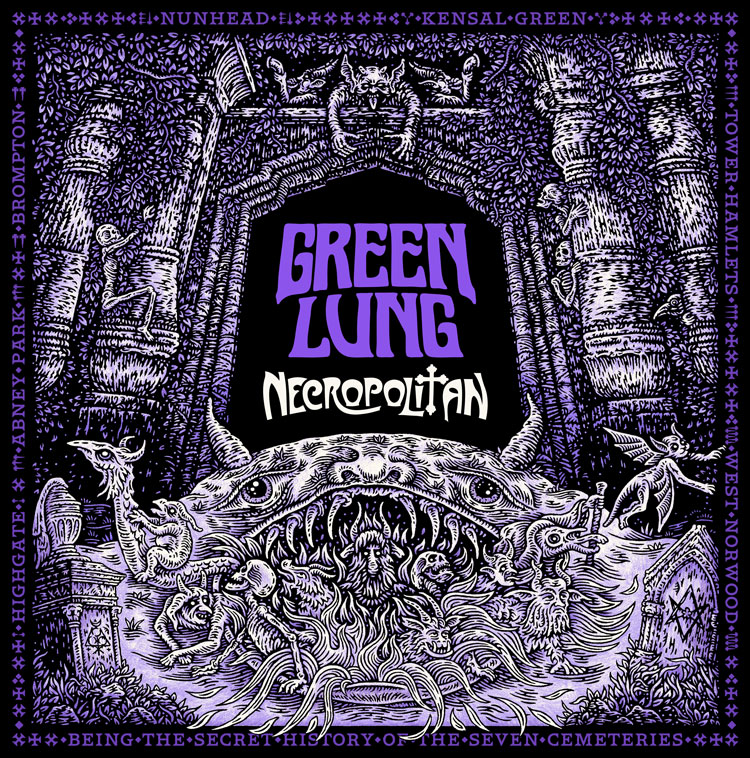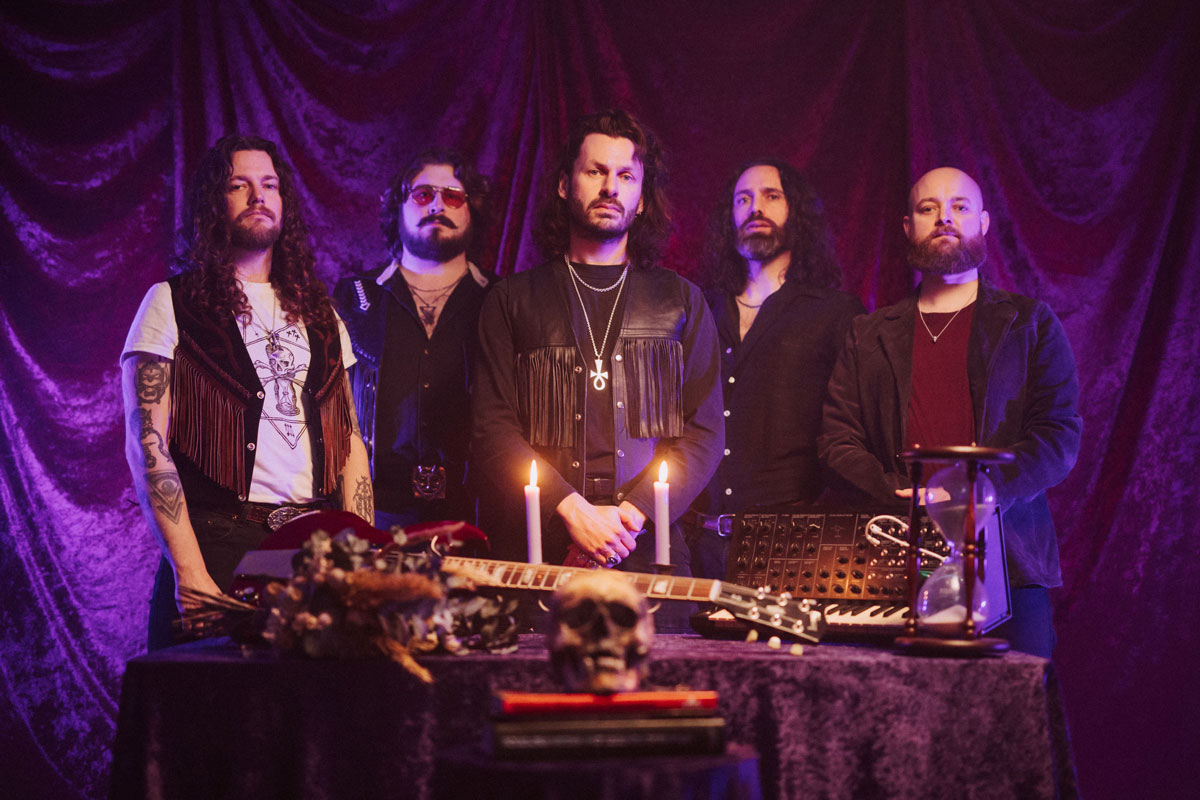
There is something beautifully appropriate about Green Lung making an album about death, decay and the inevitable destruction of civilisation.
Not because the London five-piece sound like they’re running out of ideas, quite the opposite. But because “Necropolitan” feels like a band fully aware that the best way to keep heavy music alive is to understand where it came from, rip the good bits out of the grave and set them on fire.
Since forming in London in 2017, Green Lung have steadily carved out one of the most recognisable identities in modern British heavy music. Starting with the “Free the Witch” EP in 2018 before delivering “Woodland Rites” in 2019 and “Black Harvest” in 2021, the band built their reputation around huge Sabbathian riffs, Hammond organ, psychedelia, folk horror and an obsession with Britain’s darker folklore. Their 2023 Nuclear Blast debut, “This Heathen Land”, expanded that formula considerably, turning Green Lung from an underground cult proposition into one of the UK’s most exciting traditional heavy metal bands.
Now comes “Necropolitan”, their fourth full-length, and rather than simply trying to make this “This Heathen Land II”, Green Lung have taken their mythology somewhere much closer to home. London.
The album takes its name from the city’s seven Victorian garden cemeteries, the so-called Magnificent Seven and uses those sprawling, overgrown burial grounds as a metaphor for humanity’s arrogance. We build monuments, cities, and empires, and eventually nature climbs over a lot of them. It is an idea that fits Green Lung almost too perfectly: ancient occultism meeting modern Britain, with the dead watching from underneath the pavement.
Musically, however, this is where things get interesting.
Where “This Heathen” Land could sometimes feel deliberately expansive and heavily layered, Necropolitan has been constructed to sound more physical. Producer Tom Dalgety, whose credits include Ghost and Opeth, took the band to Rockfield Studios in January 2026, with the intention of capturing their enormous live presence rather than burying it underneath endless studio decoration. Drums, bass and rhythm guitars were recorded live, giving the record a greater sense of movement and allowing the riffs to breathe and punch rather than simply exist as perfectly polished studio objects.
And you can hear it.
“Open the Hellmouth” is a short, suitably theatrical doorway into the record before “Dance to the Grave” kicks the coffin lid off completely.
There is no subtle introduction here. Scott Black’s guitar comes swinging in with a riff that seems designed to make neck muscles contract involuntarily, while Joseph Ghast and Matt Wiseman provide the weight underneath. Wiseman, in particular, is one of Green Lung’s secret weapons. He doesn’t need to constantly announce himself with technical fireworks; his playing is all about momentum, groove and knowing exactly when to hit the accelerator. That approach is crucial to the album’s more immediate sound.
“Dance to the Grave” also establishes one of Necropolitan’s biggest strengths: song structure.
Green Lung understands that a great heavy metal song needs more than a great riff. They build tension, introduce hooks, strip sections back and then bring the weight crashing down again. The huge mid-song chant gives the track a live quality, while Tom Templar’s vocals sit somewhere between classic British metal storytelling and the theatrical delivery that has become one of Green Lung’s trademarks.
Templar has always been one of the band’s defining weapons. He can sing melodically without losing the menace, and here he sounds increasingly comfortable commanding these enormous arrangements. There is a theatricality to his delivery, but it rarely feels like pantomime. Instead, he sounds like a narrator dragging you through London’s darker history with a lantern in one hand and a bloody book of folklore in the other.
Then comes “Black Magick Radio”, and this is Green Lung embracing their inner weirdos.
The song imagines London’s 1960s occult underground as a kind of supernatural pirate radio station, referencing the Process Church and Soho’s infamous Le Macabre café. Musically, it is dripping with vintage keyboard colour, groove and atmosphere. John Wright’s organ work is particularly important here, because his contribution prevents Green Lung from simply becoming another Sabbath worship band.
Wright doesn’t merely decorate the riffs. He argues with them.
His Hammond parts weave around Black’s guitar, creating that classic Deep Purple-style tension between organ and six-string, while Mellotron textures add a strange, haunted quality. It is one of the reasons Green Lung can sound unmistakably rooted in the early seventies while still feeling like a modern band.
And then “Necropolitan Line” arrives like a train that has completely forgotten where the brakes are.
Inspired by London’s Necropolis Railway, which transported the dead away from the capital during the Victorian era, the song is Green Lung at their most gloriously excessive. It has the swagger of Motörhead, the guitar-and-organ interplay of Deep Purple and the storytelling instincts of Iron Maiden, yet somehow doesn’t collapse under the weight of its influences.
That is one of Green Lung’s greatest achievements.
They wear their influences proudly, but they understand the difference between homage and imitation.
Scott Black is arguably the central architect of Green Lung’s sound, and his guitar work across Necropolitan demonstrates just how much space he can create within a riff. He isn’t interested in simply making everything heavier. Instead, he knows when a riff needs to stomp, when it needs to swing and when it needs to step aside for Wright’s organ.
Ghast and Wiseman form the muscular foundation underneath it all. The bass has a particularly satisfying presence throughout the record, refusing to simply double the guitar while Wiseman keeps everything moving with a drummer’s version of controlled violence.
Then there is John Wright.
If Black is the band’s engine, Wright is the haunted machinery surrounding it. His Hammond and Mellotron work provides much of Necropolitan’s atmosphere, particularly when the band moves away from straightforward heavy metal and into gothic, psychedelic territory.
And Tom Templar? He sounds bloody fantastic.
His performance is particularly strong when the songs slow down, allowing him to tell the story rather than simply attack the chorus. That becomes increasingly important during the second half of the album.
“Evil in this House” is the obvious monster in the room. Already released as a single, it sounds like someone locked a stoner metal band inside a haunted house and told them they weren’t allowed out until they found the ghost. The main riff is enormous, the groove is filthy, and the ectoplasmic synth solo provides one of the album’s strangest and most memorable moments.
But the record doesn’t simply remain at maximum volume.
“Together in Death” slows the pace, introducing a more gothic and baroque atmosphere. It has an almost theatrical balladry, evoking the darker side of Alice Cooper without becoming a tribute act. The arrangement gradually grows teeth again, proving that Green Lung understands dynamics just as well as they understand riffs.
Then “Ozymandias” throws another curveball.
Based around Percy Bysshe Shelley’s famous 1818 sonnet about the collapse of a once-mighty ruler, the track mixes swaggering heavy metal with percussion inspired by seventies Afrobeat and a jazz-flavoured solo section. It could have been a ridiculous musical Frankenstein, but instead it becomes one of the album’s most interesting pieces.
This is Green Lung demonstrating that traditional metal doesn’t have to mean predictable songwriting.
“Alostrael (Be My Babalon)” brings Castle Rat’s Riley Pinkerton into the story for narration, adding another theatrical voice to an already wonderfully strange record. The song feels like another chapter in the band’s growing occult mythology, with the guitar, keyboards and vocals working more like pieces of a soundtrack than a conventional rock song.
And then everything leads towards “To the Gallows Born”.
Inspired by the infamous Tyburn gallows, the closer is appropriately enormous. Rather than ending with a final blast of speed, Green Lung let the song build. Templar’s vocals become increasingly commanding while Black, Wright, Ghast and Wiseman slowly stack the musical bricks until the whole thing becomes a towering monument.
It feels like the credits rolling on a particularly grim British horror film.
Except the monster wins.
There is a danger with a band like Green Lung that the influences become more interesting than the music itself. Black Sabbath. Deep Purple. Judas Priest. Iron Maiden. Motörhead. Alice Cooper. The references are everywhere.
But Necropolitan demonstrates that Green Lung has reached the point where those influences are now ingredients rather than instructions.
This isn’t a band desperately attempting to recreate 1972.
This is a modern London band taking the DNA of British heavy music and twisting it around their own obsessions – cemeteries, folklore, occultism, ruined empires, nature and the strange history hiding underneath the streets they grew up around.
The decision to strip back some of the studio excess of “This Heathen Land” has paid off. “Necropolitan” feels heavier because it feels human. You can almost hear the five musicians pushing against each other in the room, Hammond screaming alongside the guitar, the bass and drums locking into the groove and Templar standing over the whole bloody thing like the master of ceremonies.
Most importantly, the songs stick. The riffs stick, the choruses stick, and the stories stick.
Green Lung have spent nearly a decade digging through Britain’s musical and folkloric graveyards. With “Necropolitan”, they have finally built their own mausoleum.
And judging by the noise coming from inside, there is absolutely no intention of resting there.
Review: Joseph Mitchell
Necropolitan is out via Nuclear Blast Records on 11th September 2026