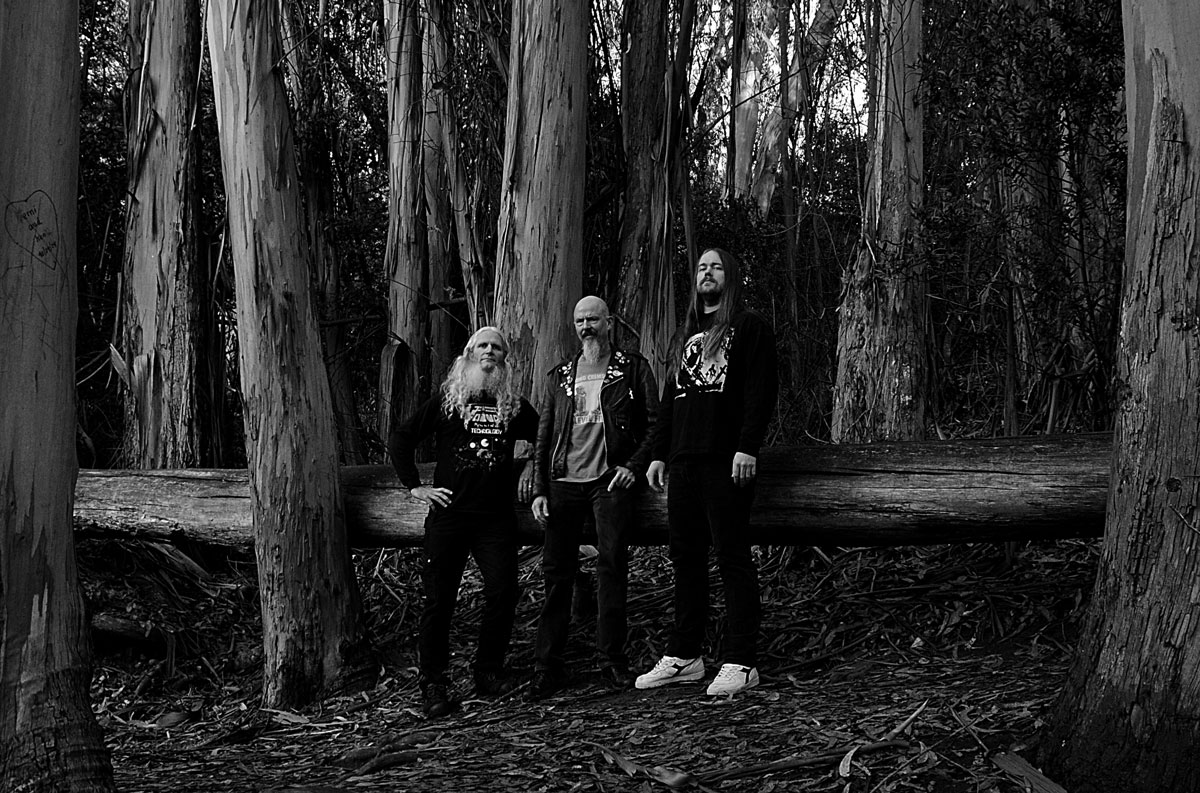
Certain names in extreme metal carry enough history to make the introduction almost redundant. Chris Reifert is one of them. From his foundational work with Death through Autopsy, Abscess and countless other filthy corners of the underground, Reifert has spent decades proving that death metal does not need to be polished, clinical or particularly interested in behaving itself. Greg Wilkinson is cut from a similarly grimy cloth, having carved his own path through projects including Deathgrave and Brainoil, while also becoming an integral part of Autopsy.
So when the pair joined forces in 2021 under the name Static Abyss, expectations were always going to be fairly straightforward: death metal, doom metal, crust, filth and probably something that sounds like it was dragged screaming from underneath an Oakland sewer.
Three albums into the project, however, Static Abyss have established that this isn’t simply an Autopsy side project where the leftovers get thrown into a different bucket.
“The Dying Hunt” is the third chapter in that particular descent, and although the ingredients remain recognisable, the execution has become considerably more aggressive. With Necrot’s Chad Gailey now occupying the drum stool, Static Abyss have discovered another gear. The songs hit harder, the faster sections feel more violent, and the contrast between their crawling doom passages and bursts of death-metal savagery is more pronounced than ever.
And yet, underneath all that brutality, there is something strangely hypnotic happening. This is an album that wants to drag you into the swamp rather than punch you in the face. And once you’re in, good luck finding the way out.
Static Abyss emerged in the early 2020s with a very simple but extremely potent foundation: Chris Reifert on vocals and drums and Greg Wilkinson on guitar and bass. Both men were already deeply embedded in the Autopsy mythology, but Static Abyss gave them another outlet to explore the darker, slower, and more psychedelic side of their musical personalities.
Their debut, “Labyrinth Of Veins”, was released on Peaceville Records in April 2022. The record immediately established the band’s DNA: old-school death metal colliding with doom, crust punk and a particularly rotten strain of atmosphere. Tracks such as “Feasting On Eyes,” “Nothing Left To Rot,” “Jawbone Ritual” and the title track demonstrated that Static Abyss were interested in more than simply recreating Autopsy.
There was speed, certainly, but there was also space. Riffs would crawl rather than charge. Wilkinson’s guitar would suddenly peel away into eerie, almost hallucinogenic leads while Reifert’s vocals sounded as though they had been excavated from the same grave as the riffs.
If the debut established the parameters, “Aborted From Reality” arrived in 2023 and immediately started pushing against them.
The second record retained the band’s death/doom/crust foundation but felt more confident and more expansive. Tracks like “Wormskinned” brought atmosphere and dissonance, while “Cathedral Of Vomit” demonstrated just how effective Static Abyss could be when they allowed a riff to sit there and rot.
Two albums in, Static Abyss were no longer an intriguing experiment.
They were becoming their own beast.
Now comes “The Dying Hunt”—eleven tracks, roughly thirty-six minutes.
And absolutely no interest in wasting your time.
The album opens with “Skull Blasted”, and the title is about as subtle as the music itself. At just under two minutes, it doesn’t bother with a lengthy introduction or atmospheric throat-clearing. The drums hit, the guitars erupt, and Reifert immediately sounds as if he’s been locked in a tomb for several hundred years and has finally found the key.
This is where Chad Gailey makes his presence felt.
The Necrot drummer gives Static Abyss a noticeably harder rhythmic backbone. Previous incarnations of the band could lumber beautifully, but Gailey brings a more immediate violence to the faster material. The opening track feels tighter, more muscular and more aggressive, with the crust influence becoming particularly obvious.
Then, just when you’re getting comfortable, “Lobotomized At Last” arrives. The title could probably describe the experience of listening to the entire record.
The riffing is ugly in exactly the right way. There is nothing particularly interested in technical showboating here. Wilkinson’s guitar work is about texture, movement and atmosphere. He knows when to make a riff sound enormous and when to let a strange lead line hang over the top of it like smoke.
That becomes one of the defining characteristics of “The Dying Hunt”.
The guitar doesn’t simply accompany the rhythm section. It haunts it.
The album’s title track is where Static Abyss really demonstrates their ability to construct a journey within a relatively compact song.
“The Dying Hunt” moves between conventional old-school death-metal riffing and much slower, hypnotic passages, with Wilkinson repeatedly creating tension through dissonant and spiralling guitar lines.
It is familiar territory for Static Abyss, but the execution is stronger.
There is an almost cinematic quality to the arrangement. The song feels like something pursuing you through an increasingly narrow corridor. Every time you think you’ve found some breathing space, the walls start moving again.
And then there is Reifert. At this stage, discussing Chris Reifert’s voice simply in terms of “death-metal vocals” feels inadequate. His delivery has always possessed a distinctive personality, but here it has a particularly nasty edge. He can bark, growl, snarl and almost speak his way through a lyric without ever losing that unmistakable Reifert character.
Importantly, his voice doesn’t sound like a man trying to imitate his younger self. It sounds lived in. Decades of death metal have given that voice weight.
“Wall Of Delusion” is brief, nasty and effective, acting almost like a decomposing interlude before “Once A Corpse (Always A Corpse)” drags the listener back into the muck.
The latter is another example of Static Abyss understanding that heaviness isn’t necessarily about speed. There is something wonderfully primitive about the riffing. It doesn’t need twenty different sections or a progressive-metal time signature to make its point. Wilkinson and Gailey establish a groove, Reifert gets inside it, and the whole thing starts to feel physically unpleasant.
That is one of the band’s greatest strengths. They understand weight.
Then comes “Bleeding In The Fog”, one of the record’s most interesting compositions. Here the band lean further into the collision between death metal, doom and crust punk. The song doesn’t remain in one emotional state for very long. It can sound almost agonisingly slow before suddenly kicking into a more frantic attack.
That unpredictability prevents the doomier sections from becoming stagnant. And that is important, because the danger with this kind of music is obvious. If everything is slow, everything becomes slow.
Static Abyss avoids that trap by making speed a weapon rather than a default setting.
“Sinew Leech” is where the psychedelic side of Static Abyss becomes particularly fascinating. This isn’t psychedelic metal in the traditional sense. There are no lengthy prog-rock excursions or sprawling instrumental jams designed to demonstrate technical ability.
Instead, the psychedelia is in the texture. The guitars bend perception.
The riffs seem to twist rather than move forward. The atmosphere feels unstable.
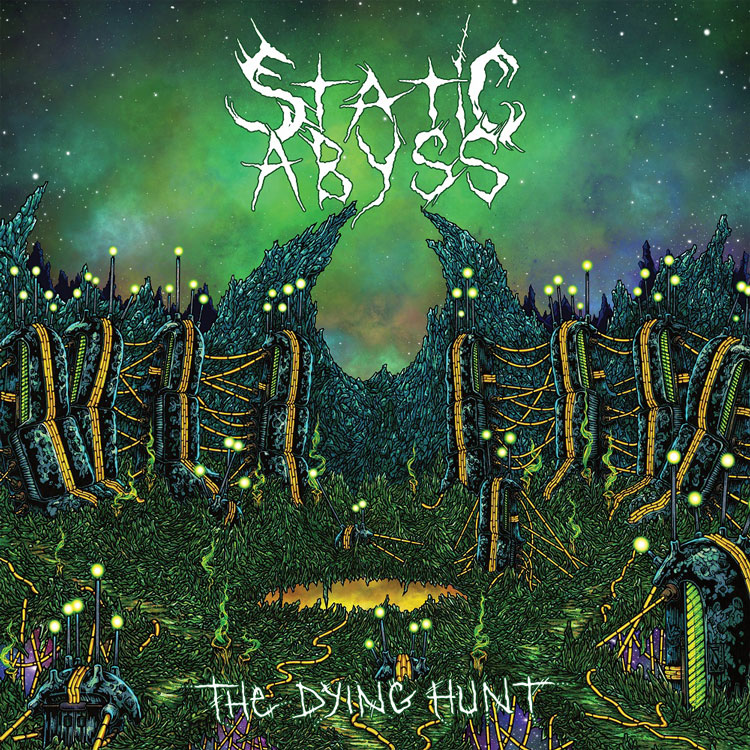
This is where Jon Santos’s artwork becomes particularly appropriate. The visual world surrounding “The Dying Hunt” feels like the sonic equivalent of some hideous hallucination, and the music frequently behaves the same way.
The record isn’t merely dark. It is disorientating in the best way.
Production-wise, “The Dying Hunt” was recorded at Earhammer Studios in Oakland, California, with Wilkinson overseeing the engineering, mixing and mastering. That choice makes perfect sense.
Earhammer has long been associated with the kind of ugly, organic extreme-metal production that Static Abyss requires. The album doesn’t sound artificially filthy. It sounds naturally filthy.
The guitars have enough definition for Wilkinson’s strange leads to cut through the murk, while the bass and drums provide the necessary physicality.
Gailey’s arrival is particularly significant.
His drumming gives the album an additional sense of urgency. The slower passages remain heavy, but the faster sections now feel genuinely violent. The percussion isn’t simply there to keep time; it helps dictate the emotional temperature of the songs.
And this is perhaps the biggest development on “The Dying Hunt.
Static Abyss are becoming more dynamic. The contrast between brutality and atmosphere is sharper than before.
The next evolution from the band comes from “Nowhere Forever.”
At over five minutes, it is the longest track on the record and arguably one of its most ambitious.
The opening atmosphere is strange and uncomfortable, with Wilkinson’s guitar creating an almost fever-dream quality before the song shifts into heavier, faster passages. This is Static Abyss at their most expansive.
It doesn’t feel like a band desperately trying to prove they can write a five-minute song. It feels like they finally have enough confidence in their own atmosphere to let a song breathe.
At this point, “The Dying Hunt” could easily become predictable.
It doesn’t, with “Defleshed & Forlorn” lasting barely over a minute, serving as another vicious punctuation mark in the album’s sequencing.
As the album nears its close, the band still has a lot of piss & vinegar; “Volcanic Womb” is a total eruption.
This is where the Autopsy connection becomes impossible to ignore.
There are riffs here that could comfortably exist within the more twisted corners of Reifert and Wilkinson’s main band, and frankly, why wouldn’t there be? Two-thirds of Static Abyss are Autopsy. The difference is that Static Abyss consistently lean further into the doom, crust and psychedelic aspects.
Rather than simply being Autopsy without the other members, they sound like a parallel universe where the same musicians were encouraged to explore the nastier corners of their own musical instincts. That distinction matters.
Because “The Dying Hunt” doesn’t sound like a collection of rejected Autopsy riffs. It sounds thankfully like Static Abyss.
The closing track, “Darkness At The End Of The Light,” is appropriately bleak. It is also one of the clearest demonstrations of the band’s ability to create atmosphere without sacrificing heaviness.
The industrial edge that creeps into the opening moments gives the song a cold, mechanical quality before it begins sinking into something much more traditionally doom-laden.
There are echoes of early Celtic Frost in the primitive heaviness and sinister simplicity, while the guitar work retains the strange Wilkinson character that runs throughout the album. The result is not a triumphant finale. There is no sense of escape. There is only darkness. And then the record ends. Perfect.
The songwriting on “The Dying Hunt” is built around contrast. Fast against slow. Clean-ish atmosphere against absolute ugliness. Groove against chaos—melody against dissonance.
That formula has existed forever. But Static Abyss have a particularly rotten way of putting it together.
The album also benefits enormously from its running time. At around thirty-six minutes, there is enough material to establish an atmosphere without overstaying its welcome. Shorter tracks punctuate the longer compositions, constantly pulling the listener between different forms of extremity. The sequencing is particularly effective.
“Skull Blasted” gets you moving, “The Dying Hunt”** pulls you deeper & “Bleeding In The Fog” expands the palette. That isn’t accidental.
The easiest criticism to level at “The Dying Hunt” is that Static Abyss haven’t completely reinvented themselves. And that’s true.
If you’ve heard “Labyrinth Of Veins” and “Aborted From Reality”, you already know the basic ingredients. But that isn’t necessarily the point.
Static Abyss aren’t a band desperately searching for a new identity.
They have found one. What “The Dying Hunt” does is perfectly sharpen it.
Death metal is nastier. The doom sections are heavier. The crust elements hit harder. The psychedelic guitar work is somehow even stranger.
And Chad Gailey’s drumming gives the whole thing an extra punch, making the faster material particularly vicious. There is also a confidence here that wasn’t quite as pronounced on the debut.
“The Dying Hunt” feels like ownership. This is now unmistakably Static Abyss.
The band have taken the rotting corpse of old-school death metal, injected it with doom, crust, psychedelia and a healthy dose of Oakland filth, then somehow managed to make it move again.
Review: Joseph Mitchell
The Dying Hunt is out via Peaceville on 28th August 2026