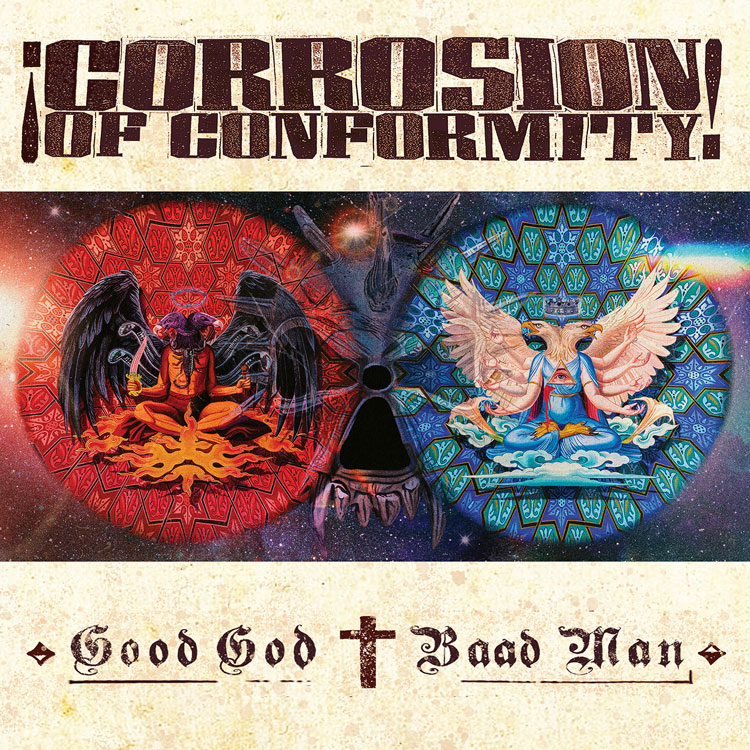
Few bands in heavy music have travelled a road as long, strange, and influential as Corrosion of Conformity. From scrappy hardcore beginnings in the early ’80s to becoming one of the defining architects of sludge, stoner, and Southern metal, their journey has always been about evolution without compromise. With “Good God / Baad Man”, the band returns after an eight-year gap, not just with a new record, but with a statement that feels as much like a reckoning as it does a revival.
This is not a casual comeback. It’s a double album shaped by loss, reinvention, and the weight of legacy. And in many ways, it stands as one of the most emotionally resonant and musically expansive releases in their catalogue.
To understand “Good God / Baad Man”, you have to start with absence, specifically, the loss of founding drummer Reed Mullin, who passed away in 2020. Mullin wasn’t just a drummer; he was a core architect of the band’s rhythmic identity, helping define their transition from hardcore punk chaos into the slow, crushing grooves that would later influence sludge metal as a whole. His absence looms large over this record.
The current lineup, Pepper Keenan (vocals/guitar), Woody Weatherman (lead guitar), Bobby Landgraf (bass), and Stanton Moore (drums), approach the material with a sense of purpose that feels almost reverent.
Moore, known for his work with Galactic, brings a different feel to the kit. Less rigid, more fluid, almost jazzy in places, but crucially, he doesn’t try to replace Mullin. Instead, he expands the band’s rhythmic vocabulary, allowing the songs to breathe in new ways.
Structurally, “Good God / Baad Man” is split into two distinct halves. a decision born from an overwhelming volume of material and diverging creative directions.
“Good God” leans into the band’s heavier, angrier side, dense riffs, doom-laden pacing, and palpable tension.
“Baad Man” explores a more melodic, rock-driven approach, rooted in Southern grooves and classic rock swagger.
This duality isn’t just a gimmick; it really reflects the band’s entire history. From the crossover thrash of Blind to the Southern-metal breakthrough of Deliverance, C.O.C. have always lived between extremes. Here, they embrace both sides fully.
At its core, “Good God / Baad Man” is a masterclass in genre fusion. Few bands have had as much impact on sludge metal, a genre that blends the weight of doom metal with the aggression of hardcore, and this album reinforces why.
The riffs are thick, filthy, and unmistakably C.O.C. Tracks like “The Handler” open with fuzz-drenched guitar tones that drag through molasses, while still maintaining a groove that nods to classic rock roots.
Then there’s “Gimme Some Moore”, a track that embodies the band’s jam-based chemistry. It’s loose, almost improvisational, yet anchored by a sludgy backbone that keeps it grounded.
Keenan and Weatherman’s guitar interplay remains the album’s beating heart. Their ability to shift from crushing doom riffs to bluesy, almost ZZ Top-inspired grooves is what gives the record its identity.
And throughout it all, there’s a clear lineage back to Black Sabbath not just in tone, but in the sense of space and weight.
While the album’s scale makes it difficult to single out definitive “hits,” several tracks stand out as key moments, such as “You or Me”.
A dynamic piece that shifts between restrained verses and explosive choruses, showcasing Keenan’s ability to balance melody with grit.
“The Handler” is a riff-driven powerhouse that feels like classic C.O.C.—direct, aggressive, and undeniably heavy.
While “Gimme Some Moore” is loose and groove-heavy, this track captures the band’s jam-session ethos while highlighting Moore’s drumming versatility.
One of the most compelling aspects of “Good God / Baad Man” is its use of guest musicians not as gimmicks, but as genuine extensions of the band’s sound.
On “Forever Amplified,” Anjelika ‘Jelly’ Joseph delivers a stunning vocal performance that channels a raw, soulful energy reminiscent of Janis Joplin. Her presence transforms the track into something almost transcendent, bridging the gap between sludge metal and Southern soul.
Meanwhile, Al Jourgensen of Ministry makes a subtler appearance, adding backing vocals that inject a layer of industrial grit into the mix.
These collaborations don’t dilute the band’s identity; they enhance it, highlighting just how wide the C.O.C. sonic universe has become.
Produced by Warren Riker, the album strikes a delicate balance between retro warmth and modern heaviness.
The guitars sound massive but never muddy. The drums are punchy yet organic. And the overall mix retains a distinctly 70s vibe, a nod to the band’s influences while still delivering the sonic impact expected of a contemporary metal release. It’s a production style that suits the material perfectly, allowing every riff and groove to hit with maximum force.
It’s impossible to review this album without acknowledging the band’s broader influence.
Alongside acts like Melvins and Eyehategod, Corrosion of Conformity helped define the blueprint for sludge metal, combining the slow, oppressive weight of doom with the raw aggression of punk.
Albums like Deliverance didn’t just succeed commercially; they redefined what heavy music could sound like in the 90s, paving the way for countless bands.
“Good God / Baad” Man doesn’t try to reinvent that legacy. Instead, it reinforces it, showing that the band can still operate at a high level while staying true to their roots.
While lyrically, the album feels introspective without becoming self-indulgent. Themes of control, disillusionment, and resilience run throughout the record, often delivered through Keenan’s gritty, world-weary vocal style. There’s a sense that the band is looking both inward and outward, grappling with personal loss while also reflecting on the state of the world around them.
“Good God / Baad Man” is not a perfect album, but it’s not trying to be.
It’s sprawling, occasionally uneven, and unapologetically dense. But those qualities are part of its charm. This is a record that demands time and attention, revealing new layers with each listen. More importantly, it feels honest….
In the shadow of Reed Mullin’s passing, this album could have easily felt like a band going through the motions. Instead, it feels like a band rediscovering its purpose.
For longtime fans, it’s a powerful reminder of why Corrosion of Conformity matters. For newcomers, it’s a compelling entry point into a band that helped shape the sound of heavy music for over four decades.
And in a genre often obsessed with either nostalgia or reinvention, “Good God / Baad Man” manages to do something far more difficult. It simply endures….
Review: Joseph Mitchell
Good God / Baad Man is out via Nuclear Blast on 3rd April 2026